


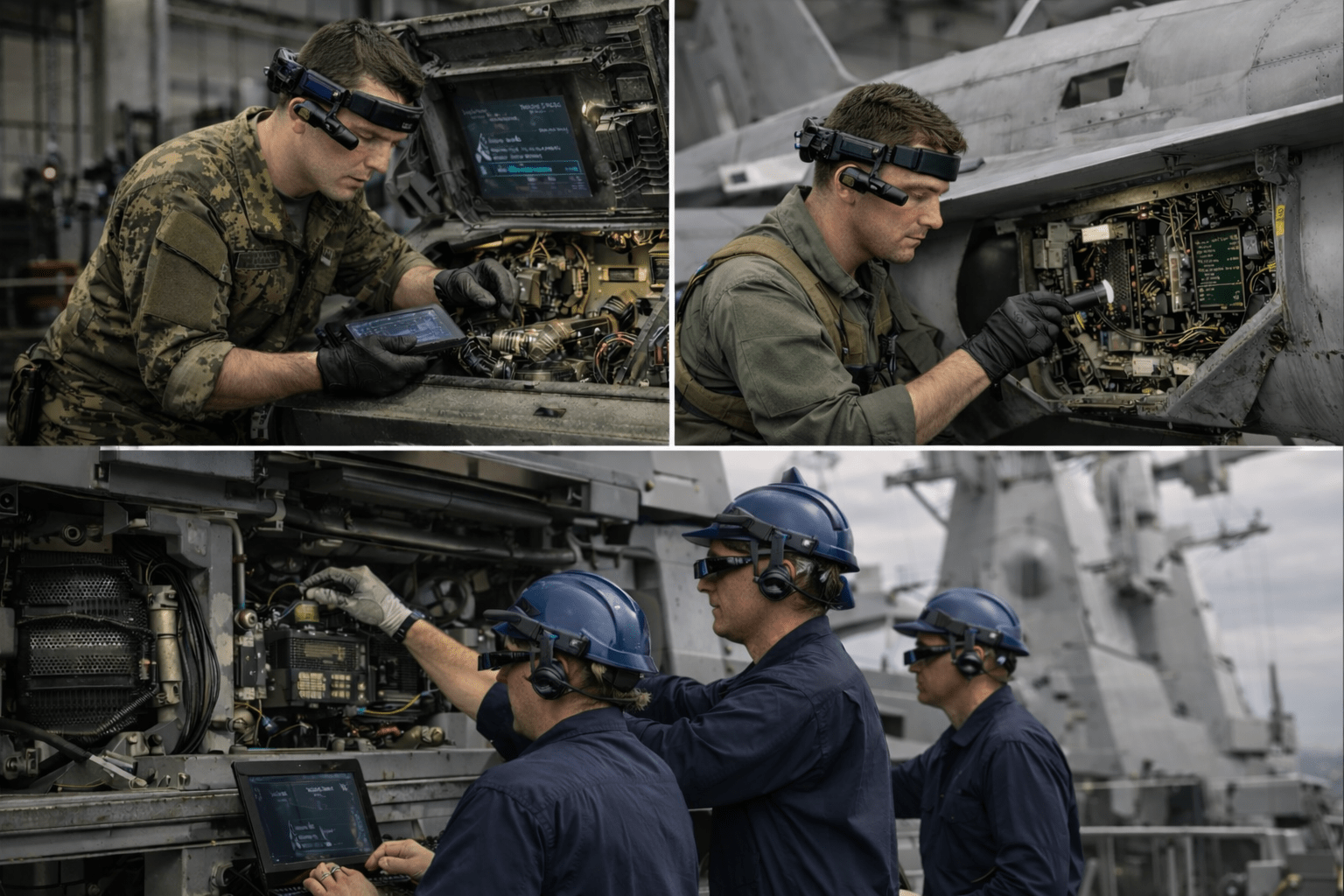
Maintenance of defence systems is probably one of the most demanding sustainment operations that exist.
Not only because of the technical complexity of the equipment — radars, combat systems, and air, naval and land platforms with thousands of critical components — but also because of the conditions in which the work is carried out: technicians working at bases distributed throughout the territory, sometimes abroad, often without stable connectivity, following procedures that cannot fail and with the obligation to maintain complete traceability of every intervention.
For decades, this work has been done with essentially the same tools: paper documentation, phone calls to consult an expert, manual records, and a heavy reliance on the individual knowledge of the most experienced technicians.
It works. Until it doesn’t.
The invisible cost of fragmented systems
In defence support, management systems already exist. Most large companies in the sector have ERP systems, CMMS platforms and configuration databases. The problem is not the absence of systems — it is the distance between those systems and the technician physically working on the equipment.
The field technician must consult procedures in a PDF manual that may not be up to date. They need to call an expert in Madrid to resolve a question about a specific system. They complete the intervention report by hand and submit it on paper so that someone can transcribe it later. And if an unusual incident occurs, it is reported by phone and the technician waits for further instructions.
Each of these steps has a cost: longer resolution times, increased risk of errors due to outdated information, dependency on specific individuals, and traceability that is incomplete at best.
In an environment where the operational availability of systems is a contractual requirement — and where penalties for non-compliance are real — that cost matters.
What changes when the technician is connected
The digitalization of support does not start with the core systems. It starts with the technician in the field.
When that technician has access, directly from the asset itself, to updated procedures linked to that specific system, the history of previous interventions, relevant technical documentation, and the possibility of connecting in real time with a remote expert — the situation changes completely.
Diagnostic time is reduced because the technician no longer needs to search for information; the information is available exactly where the work is being performed. Interventions are executed with greater precision because procedures can be followed step by step with appropriate visual guidance. Traceability is generated automatically, without additional administrative work, because data registration becomes a natural by-product of digital operations. And the expert can remain in Madrid while assisting a technician in real time in Cartagena, Zaragoza, or even during a mission abroad.
This is not a hypothetical scenario. This is what Indra Defensa has implemented with 4SmartWorker in its In-Service Support division, applied to the maintenance of electronic defence systems, radars and simulators — both for internal use and within the maintenance services it provides to its end customers.
The specific requirements of the defence environment
Digitizing operations in the defence sector involves requirements that do not exist in many other industrial environments.
The first is offline capability. Technicians frequently work in environments without connectivity — remote bases, naval platforms, or aircraft on the ground. The tool must work offline and synchronize data when connectivity becomes available. Without this capability, digitalization is not viable in field operations.
The second is security. Maintenance data for defence systems is highly sensitive. On-premises deployment — on the organization’s own controlled infrastructure, without reliance on external cloud servers — is not optional; it is a requirement. It is the only way to ensure that operational data never leaves the organization’s security perimeter.
The third requirement is integration with existing systems. Large companies in the sector already operate with consolidated IT infrastructures. The field digitization tool cannot function as a standalone silo — it must integrate with existing ERP, CMMS and asset management systems without duplicating information or creating additional data silos.
The fourth requirement is adaptability to internal procedures. Each defence system has its own maintenance procedures, regulations and traceability requirements. The platform must be configurable so that it accurately reflects the processes of each organization, without imposing generic structures that do not match operational reality.
The window that is opening now
The Spanish and European defence sector is currently experiencing a period of accelerated investment. Increased defence budgets, capability modernization programs and the pressure of NATO commitments are generating growing demand for more efficient and traceable sustainment operations.
At the same time, companies in the sector are incorporating increasingly demanding operational availability metrics into their sustainment contracts. This makes maintenance efficiency — and the ability to demonstrate it through data — a true competitive advantage, not just an internal operational improvement.
Organizations that are digitizing their sustainment operations today are not doing so only to become more efficient. They are doing it to remain competitive in future contracts, where digital traceability and measurable availability will not be differentiators, but requirements.